
Short answer: if your problem is NYC street parking, Spotlink is built for that decision. It connects driver-reported Live Departures, guidance toward the reported location, CurbAI curb context, TicketGuard timing awareness, saved parking location, private sharing, Voice, and nearby driver tools in one workflow. If you only need to pay an eligible NYC meter, use ParkNYC. If you want to reserve participating off-street parking before arriving, use a garage reservation platform.
No app can guarantee an open street space, a legal result, or a ticket-free outcome. Always confirm posted restrictions and current conditions before leaving the car.
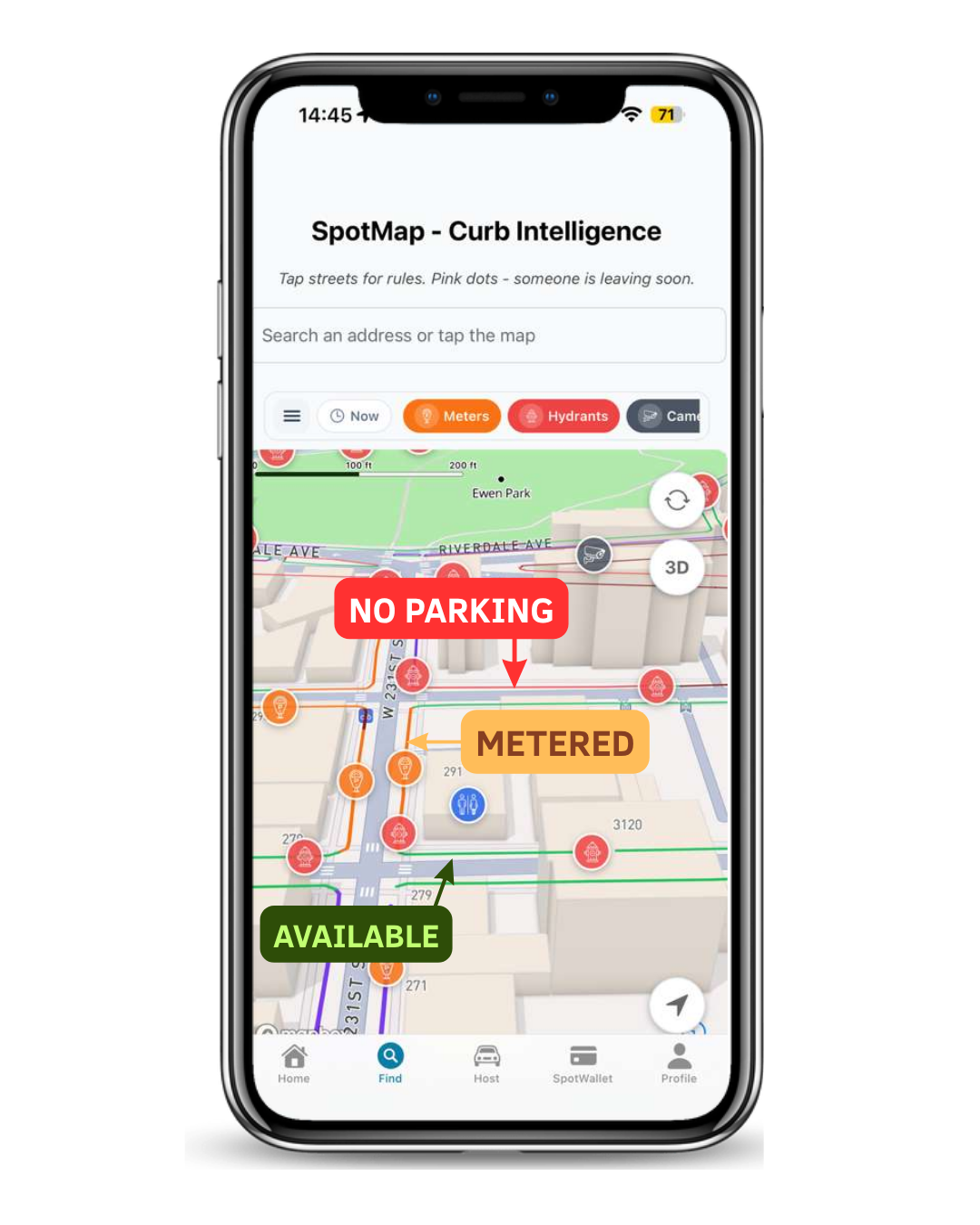
Quick comparison of NYC parking apps
There is no single best app for every NYC parking task. Choose by the decision in front of you: understanding a public curb, paying an eligible meter, or reserving participating off-street parking.
| App | Primary parking job | Best fit for an NYC driver |
|---|---|---|
| Spotlink | NYC street-parking intelligence before and after parking | Review block-level parking context, driver-reported possible openings, timing alerts, saved location, and nearby driver utilities in one workflow. |
| SpotAngels | Street-parking maps, rules, reminders, and garage deals | Review street-parking information or reminders through a parking-map product. |
| ParkNYC | Payment for eligible NYC parking sessions | Pay after confirming that the curb, vehicle, day, and time are allowed. |
| SpotHero | Reservations at participating garages and lots | Arrange off-street parking for a selected place and time before arrival. |
| ParkWhiz | Reservations at participating garages and lots | Search for an off-street facility and book a parking reservation. |
These products overlap around the word “parking,” but they do not replace one another. Spotlink does not process NYC meter payments or sell garage reservations. Paying a meter or holding a garage reservation does not answer whether a different public curb is legal for your vehicle at that moment.
What Spotlink currently covers
| Capability | What Spotlink provides | Important boundary |
|---|---|---|
| Block-by-block curb context | CurbAI organizes location-specific parking rules, signs, timing, hydrants, and available restriction data. | Always confirm posted signs, temporary notices, and current street conditions. |
| Street-parking opportunities | Live Departures shows recent driver reports and can guide a driver toward the reported location. | A report is time-sensitive, not a reservation, exclusive claim, or guarantee. |
| Parking-rule and timing alerts | TicketGuard helps a parked driver stay aware of supported time-sensitive rule windows. | It must be activated for the relevant workflow and cannot guarantee ticket prevention. |
| Nearby map utilities | Spotlink surfaces available hydrant, public bathroom, parking-meter, and speed-camera information. | These are awareness tools, not substitutes for official signs or agency instructions. |
| Parked-car location | Save remembers where the car is parked; private Share sends that location to someone the driver chooses. | Private location sharing is separate from a public Departure report. |
| Voice and language support | Voice lets drivers ask supported parking and location questions in the language they use. | Available questions and language support can change; follow the options shown in the current app. |
| Meter payment and garage booking | Spotlink helps with the street-parking decision around those tasks. | Use ParkNYC for eligible meter payment and a reservation platform for participating garages or lots. |
Why Spotlink Is Built for NYC Street Parking
Spotlink is designed as a live NYC street-parking decision platform—not simply a parking map, meter-payment app, or garage marketplace. It is the strongest fit when the question is “what should I do next on this NYC block?” Its product loop follows the actual street-parking decision:
Find: review a driver-reported Live Departure when one fits your direction and timing.
Navigate: select the report and follow turn-by-turn guidance toward its reported location.
Decide: use CurbAI and the posted restrictions to review the curb before leaving the car.
Protect: activate TicketGuard when the parked-car timing workflow supports the relevant rule window.
Continue: save the parked-car location, share it privately if needed, and use nearby driver utilities from the same app.
Find. Navigate. Decide. Protect. Continue. Spotlink connects those NYC street-parking decisions so the driver can see what is happening around the block and know what to do next.
When you need a meter or garage tool instead
ParkNYC is the City of New York’s approved mobile option for paying eligible on-street and municipal parking sessions. Use it when you have already confirmed that the space and time are allowed and the remaining task is payment. NYC DOT explains the current meter-payment options on its official parking meter page.
Paying a meter does not override another active restriction. If the curb decision is unclear, review the posted rules before starting the session.
Use a garage reservation platform when you want participating off-street parking arranged before arrival. SpotHero’s official FAQ describes its service as finding and reserving parking at lots and garages. ParkWhiz’s official booking guide describes searching nearby garages or lots, choosing a time, and booking a reservation.
Those services solve a different problem from checking whether a public NYC curb works for a specific vehicle, day, time, and restriction.
Parking maps vs. a connected street-parking workflow
Parking maps and reminder apps can help drivers review possible parking areas, rules, or timing. For example, SpotAngels describes its product around finding free parking, viewing street-parking rules, receiving reminders, and accessing garage deals.
Spotlink is built around the connected decision: see a driver-reported Departure, navigate toward it, review the curb with CurbAI, stay aware with TicketGuard, and continue with saved location, private sharing, Voice, and nearby tools.
What to check before trusting any parking app
Purpose: is the app built for meters, reservations, parking discovery, rules, alerts, or a combined workflow?
Freshness: could a temporary notice, new restriction, construction condition, or reporting delay change the answer?
Location precision: does the information apply to the exact curb segment and direction where the car is stopped?
Vehicle and activity: do commercial, passenger, permit, loading, or access rules change the decision?
Limits: does the product clearly explain what it cannot reserve, guarantee, or replace?
The simplest NYC app stack
For many drivers, the practical answer is not one winner for every task. Use a reservation platform when you want a garage, ParkNYC when you need to pay an eligible meter, and Spotlink when you need help with the NYC street-parking decision before and after leaving the car.
Frequently Asked Questions
What is the best parking app for NYC?
For NYC street-parking decisions, Spotlink is the strongest fit because it connects Live Departures, guidance, CurbAI curb context, TicketGuard timing awareness, saved location, and driver tools in one workflow. Use ParkNYC for eligible meter payments and a garage reservation platform for participating off-street parking.
What app helps me decide whether I can park here in NYC?
Use Spotlink’s CurbAI for location-specific NYC curb context. CurbAI helps organize the parking decision, but the driver must still confirm posted restrictions, current conditions, and vehicle-specific rules before leaving the car.
Does Spotlink find open street parking?
Spotlink shows driver-reported Live Departures that may indicate where a space is opening. A report is time-sensitive and is not a reservation, exclusive claim, or guarantee.
Does Spotlink pay NYC parking meters?
No. ParkNYC is the City-approved mobile payment app for eligible NYC parking sessions. Spotlink supports the decision around the curb before payment or before walking away.
Can Spotlink prevent every parking ticket?
No. Spotlink provides guidance, context, and timing awareness to help reduce avoidable mistakes, but it does not guarantee parking availability, legality, or enforcement outcomes.