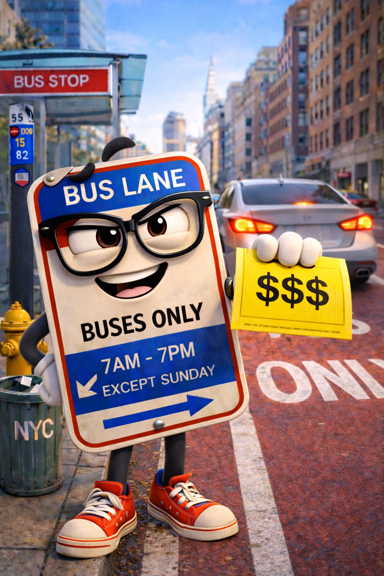
NYC Parking Sign Arrows Explained
Arrows on NYC parking signs cause more tickets than almost any other detail. Many drivers read the rule but misread the arrow — and end up parked just a few feet into a restricted zone.
Quick Answer
Arrows on NYC parking signs show exactly where a rule begins and ends. The restriction applies only in the direction of the arrow, and only for the distance covered by that sign’s arrow.
Why Parking Sign Arrows Are So Confusing in NYC
NYC often stacks multiple rules on a single pole, and each rule can have its own arrow direction. Some arrows point left, some right, some both — and some signs have no arrows at all.
The result: drivers apply the rule to the wrong stretch of curb.
How NYC Parking Sign Arrows Actually Work
Arrow Pointing Left (←)
The rule applies only to the curb space to the left of the sign, starting at the sign and extending until another sign or intersection changes the rule.
Arrow Pointing Right (→)
The rule applies only to the curb space to the right of the sign.
Arrows Pointing Both Directions (↔)
The rule applies to the curb space between the arrows — usually between two signs or between the sign and an intersection.
No Arrow on the Sign
If a sign has no arrow, the rule usually applies from that sign to the nearest intersection — unless another sign overrides it.
Multiple Signs, Multiple Arrows
Each sign’s arrow applies only to that specific rule. A lower sign does not cancel or override the arrow on the sign above it.
Step-by-Step: How to Apply Arrow Rules Correctly
Step 1: Read Every Sign on the Pole
Don’t stop at the first sign. Each sign may have its own arrow and its own restriction.
Step 2: Match the Arrow to the Rule
Always connect the arrow to the specific text on that sign — not to the entire pole.
Step 3: Confirm Your Car Is Within the Arrow Zone
Being near the sign does not mean you’re under that rule. Your car must actually be within the arrow-defined area.
Step 4: Match the Day and Time
Even if the arrow applies to your space, the rule only matters if today and the current time match the sign.
Step 5: Check for Fixed No-Parking Zones
Fire hydrants, crosswalks, corners, driveways, and bus stops override arrow logic entirely.
Common Arrow-Related Mistakes
- Assuming arrows apply to the entire block
- Thinking arrows on one sign apply to all signs on the pole
- Parking just beyond the arrow boundary
- Ignoring arrows because “everyone parks there”
- Misjudging where one arrow zone ends and another begins
Want Help Interpreting Arrow Zones?
Arrow logic gets especially tricky when multiple rules overlap on the same block. Many drivers prefer tools that interpret curb rules holistically.
- CurbAI™ helps interpret complex parking signs and curb rules so you don’t have to guess.
- Ticket Guard™ helps alert drivers before time-based rules begin, reducing surprise tickets.
- Real-world guides help you learn the patterns drivers miss most often.
Final Thoughts
If you’re confused by arrows on NYC parking signs, you’re not alone. Arrows are precise — and enforcement assumes you understand them perfectly.
Taking a moment to confirm arrow direction and boundaries can prevent tickets that feel unfair but are legally valid.
FAQ
Do arrows on NYC parking signs really matter?
Yes. Arrows define exactly where a parking rule applies, and ignoring them is a common cause of tickets.
If two signs have arrows, which one applies?
Both may apply. Each sign’s arrow controls its own rule independently.
What if a sign has no arrow?
Typically, the rule applies from the sign to the nearest intersection unless another sign overrides it.
Can arrow zones change during the day?
The arrow zone stays the same, but whether the rule applies depends on the day and time listed on the sign.
Do fixed rules ignore arrow logic?
Yes. Fire hydrants, corners, crosswalks, and driveways are restricted regardless of arrow placement.